Sixty-four sources. Two hundred and fifty-five displays. Infinite routing possibilities. In 2026, Indian enterprise IT departments are abandoning hardware matrices in droves, turning instead to standard Ethernet networks to route their audio and video. The shift toward AV over IP solutions India is happening fast because the technology treats video like data. It moves high-bandwidth signals across existing corporate networks using encoders and decoders, completely bypassing the distance and scaling limits of traditional cabling.
According to a 2022 technical demonstration by Eaton, a single AV over IP transmitter can send a signal 328 feet over standard cabling. Add a network switch, and you extend that range by another 328 feet. You can keep adding switches. This is why multi-location offices are upgrading now. They need the distance, the scale, and the agility.
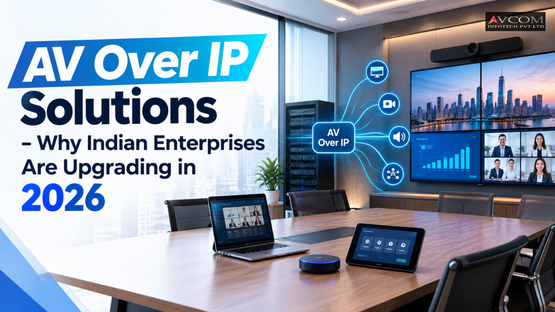
AV over IP solutions India transmit audio, video, and control signals as data packets across standard Ethernet networks rather than using dedicated point-to-point cables. Encoders convert the raw HDMI feed into network traffic, while decoders on the display side rebuild those packets back into a perfect visual output.
Legacy AV setups relied on fixed point-to-point wiring and hardware matrix switchers. According to OREI, these traditional hardware matrices grew heavy and costly as systems scaled, forcing businesses to rip up floors and rewire closets just to add a few displays. Standard network infrastructure changes that math. Routing happens in software or via a central control unit. Layouts change without anyone touching the cabling. Managing an AV system now feels closer to managing files on a server than wrestling with physical hardware.
The hardware backbone is remarkably simple. An encoder takes the original audio and video signals and turns them into compressed data packets. A network switch directs this traffic. On the display side, decoders rebuild those packets into a format identical to the original source.
According to PureLink, modern network switches often support Power over Ethernet. This means the switch delivers power to the encoders and decoders over the exact same cable that carries the video signal. You drop a single cable to a display, and you have both power and data.
Indian enterprises are upgrading to AV over IP solutions India in 2026 because the technology supports high-bandwidth 4K video streaming without latency and scales effortlessly across multi-location offices. The shift to hybrid work demands that local AV setups behave like centralized IT assets.
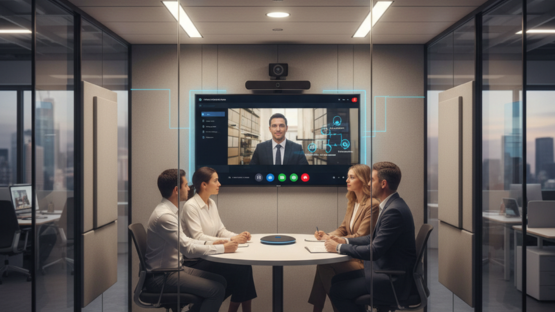
Hybrid work broke the old AV model. When a meeting includes participants in a Mumbai boardroom, remote staff in Bengaluru, and a client dialing in from London, the room's technology must bridge physical and digital spaces instantly. AV over IP handles this by putting all routing on the corporate network. An IT manager can route a presentation from a laptop in one building to screens in three different cities simultaneously. You configure it once. It just works.
Nobody tolerates a pixelated, lagging presentation. Modern AV over IP solutions India use specific networking features to keep high-bandwidth 4K video smooth. Multicast routing sends one video stream to multiple displays without duplicating the traffic and clogging the network. Internet Group Management Protocol snooping ensures only the right screens receive that multicast feed. Virtual Local Area Networks keep AV traffic separate from everyday business use. Quality of Service prioritizes AV packets so audio and video stay crisp even when the network is busy.
When comparing AV over IP vs HDBaseT for conference rooms, AV over IP wins on scalability and distance by using standard network switches, whereas HDBaseT relies on point-to-point cabling that strictly limits how far a signal can travel and how many displays you can connect.
HDBaseT is a fantastic technology for a single room. It sends uncompressed 4K video, audio, ethernet, power, and control signals down a single Cat5e or Cat6 cable. But it is fundamentally a point-to-point technology. You have one source, one cable, and one display. If you want to route that same source to three different conference rooms on different floors, you need a physical matrix switcher. The hardware gets expensive. The cabling gets messy.
Standard IP networks destroy these limitations. According to Eaton's AV over IP deployment guide, adding a network switch allows you to support multiple sources and multiple displays. By adding multiple switches to your installation, a single system can support up to 64 transmitters and 255 receivers. You are no longer constrained by the length of a single cable run. You are constrained only by the size of your corporate network.
The benefits of AV over IP for multi-location offices include centralized management of audio-video systems across geographical locations and seamless integration with existing corporate IT networks. This allows a small IT team to manage dozens of regional offices from a single dashboard.
Managing legacy AV systems across a dispersed enterprise meant dispatching technicians to fix loose cables or reconfigure hardware matrices. AV over IP puts all that control onto the network. According to OREI, this approach brings remote management and routing to the same tools IT teams already use. An administrator in Hyderabad can push a firmware update to decoders in Delhi, re-route a video feed to a different branch office, and set up a new video wall without leaving their desk.
Because AV over IP uses standard Ethernet, it integrates directly into the unified communications platforms businesses already run. Video traffic sits on its own VLAN, completely isolated from general office traffic. This means your AV deployment does not require a parallel, proprietary cabling infrastructure. It uses the exact same network switches, routers, and fiber backbones that your IT department already understands and maintains.
AV over IP reduces cabling and installation cost by leveraging economical Cat5e, Cat6, and fiber optic cabling instead of proprietary cables, while consolidating hardware requirements. This eliminates the need for expensive matrix switchers and drastically cuts down on the labor required to pull specialized wires.
Traditional AV extensions required specific, often proprietary cables that cost a premium. AV over IP uses the cheapest, most widely available cabling on the planet. According to Eaton, these solutions use transmitters and receivers to send signals over standard Cat5e or Cat6 cabling. For larger campus deployments, the traffic moves over existing fiber optic backbones. You buy standard network switches instead of dedicated AV matrix hardware. The total cost of ownership drops immediately.
Hardware requirements shrink. Instead of buying a massive 16x16 matrix switcher that costs a fortune and takes up a full rack space, you buy a standard gigabit network switch. You plug in encoders and decoders as needed. If a decoder fails, you swap it out in minutes. If you need to expand the system, you just add another switch and plug in a new display. Maintenance shifts from specialized AV technicians to standard IT staff.
Indian IT managers choosing an AV over IP provider should prioritize strict network security protocols, proper VLAN configuration, and guaranteed compatibility with existing unified communications platforms. The provider must understand enterprise IT, not just audio-visual hardware.
Putting audio and video on a corporate network introduces security considerations. A compromised AV system could allow an attacker to monitor meeting rooms or intercept screen shares. IT managers must ensure their provider follows strict network security protocols. The system must support dedicated VLANs to isolate AV traffic from general corporate data. IGMP snooping must be configured to prevent multicast streams from flooding the network. The provider should offer managed switches that allow for granular control over who can access the AV system remotely.
An AV over IP deployment cannot exist in a vacuum. It must talk to your existing unified communications platforms. The encoders and decoders need to interface cleanly with software like Microsoft Teams, Zoom, or Cisco Webex. When a user walks into a conference room and hits share, that signal needs to hit the network, route to the local display, and bridge to the remote participants without friction. Your provider must guarantee this integration works out of the box.
AVCOM infotech helps enterprises transition to IP-based AV systems by providing first-hand analysis of enterprise AV deployment trends in the Indian corporate sector for 2026. We do not just sell hardware. We design network infrastructure that handles seamless 4K video routing.
Our team evaluates the total cost of ownership between your legacy HDBaseT setups and modern IP networks. We configure the secure network infrastructure necessary for safe AV over IP deployments in enterprise IT environments. We map out the VLAN configurations. We ensure your encoders, decoders, and network switches are optimized for multicast routing. AVCOM infotech builds the bridge between your AV needs and your IT infrastructure, ensuring your multi-location offices operate as a single, cohesive unit.
| Feature | AV over IP | HDBaseT |
|---|---|---|
| Infrastructure | Standard Ethernet networks & switches | Point-to-point proprietary cabling |
| Scalability | Supports up to 64 transmitters & 255 receivers | Limited to a single display per cable run |
| Distance | Extends 328 feet per switch; virtually unlimited | Strictly limited by single cable length |
| Hardware | Uses standard gigabit network switches | Requires expensive physical matrix switchers |
| Management | Centralized remote control via IT networks | Requires on-site AV technician reconfiguration |
AV over IP solutions are systems that send audio, video, and control signals as data packets across standard Ethernet networks rather than using traditional point-to-point cables and hardware matrices.
IP-based AV systems use standard network infrastructure, encoders, and decoders to route audio and video. They rely on network switches and protocols like multicast routing to distribute signals to multiple displays.
When comparing AV over IP vs HDBaseT for conference rooms, AV over IP offers greater scalability and distance by using network switches, while HDBaseT relies on point-to-point cabling that limits signal distribution to a single display.
The benefits of AV over IP for multi-location offices include centralized remote management of audio-video systems across geographical locations and seamless integration with existing corporate IT networks.
AV over IP reduces cabling and installation cost by using economical standard Cat5e, Cat6, and fiber optic cabling instead of proprietary wires, eliminating the need for expensive matrix switchers.
Indian enterprises are upgrading to AV over IP solutions India in 2026 to support high-bandwidth 4K video streaming, accommodate hybrid work environments, and scale their AV infrastructure without massive cabling overhauls.