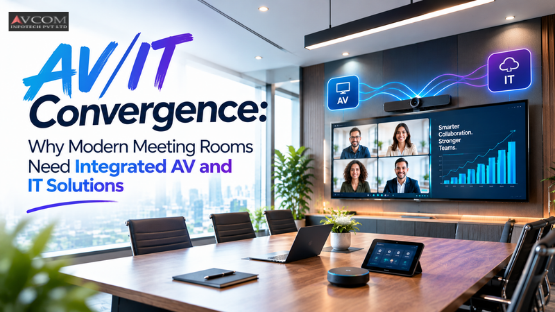
A meeting room where the video feed drops, the audio lags, and the screen-sharing fails isn't just an annoyance. It is a direct drain on enterprise productivity. For years, corporate audiovisual equipment operated on isolated "AV islands," completely detached from the standard data network. AV IT convergence is the integration of audiovisual hardware with standard IT network infrastructure. Modern meeting rooms require this converged approach because it allows centralized management, enhances cybersecurity, and supports scalable communication tools like AV-over-IP, ensuring collaboration systems function efficiently within an enterprise's broader digital ecosystem.
AV IT convergence is the process of moving audiovisual hardware onto standard IT network infrastructure, replacing isolated AV islands with networked solutions. It matters because it allows IT and AV teams to operate from the same playbook, enabling remote management, automated updates, and consistent security policies across all corporate communication devices.
Not long ago, an AV engineer's expertise was grounded in physical signal flow, impedance matching, and acoustic treatment. According to Alexis Bou Farhat, an ELV Project Manager writing for AVIXA, the industry has shifted dramatically. He notes that "we talk about network switches, VLAN configurations and IP addressing schemes as much as we discuss audio levels and projector lumens." The AV industry has stepped directly into the IT domain, creating a blended discipline that demands mastery of both worlds.
This transition began when standalone devices like projectors, monitors, and speakers started evolving into a networked IT ecosystem. Enterprise integration requirements forced AV systems to tie into Active Directory, work with enterprise authentication methods, and share infrastructure with mission-critical business applications. AV must now adhere to IT standards for uptime, security, and interoperability. The global shift to hybrid and remote work accelerated this demand, requiring networked conferencing and collaboration platforms that function reliably across distributed teams.
The shift from traditional baseband video—like HDMI, SDI, and VGA—to network-based transport is the most significant ProAV transformation in decades. AV content is now compressed, packetized, and streamed over Ethernet using protocols like Dante, NDI, AES67, and ST 2110. This requires an understanding of multicast routing, bandwidth provisioning, and latency management. AV over IP replaces the hardwired matrix switches of the past with standard network switches, allowing video, audio, and control signals to travel over the same physical cables as standard office data.
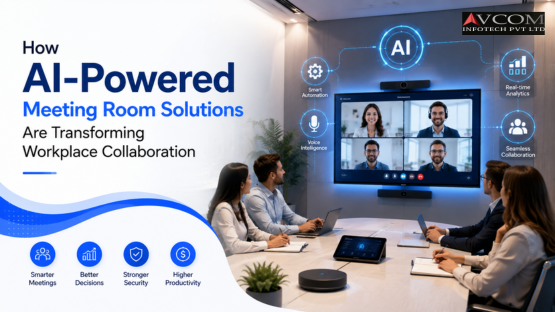
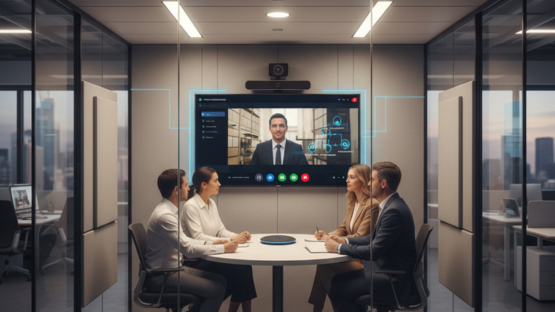
AV IT integration improves collaboration by moving video conferencing, digital signage, and access control onto a single, unified management layer. This eliminates the hardware troubleshooting that derails meetings, allowing employees to focus entirely on the content of their discussion rather than the technology enabling it.
When you design integrated AV and IT systems, meetings stop being a fight with hardware. According to Ford AV, aligning audiovisual systems with an organization's IT backbone and security policies ensures that meetings run smoother, classrooms become more engaging, and operations become more scalable. The real advantage is practical. IT and AV teams can operate from the same playbook, and security teams can apply consistent policies across devices and streams.
A unified control system means a single interface manages the room's lighting, audio levels, display inputs, and video conferencing platforms. According to Integrate Expo, the unification of AV, IT, and networking is fueling the development of smart environments. In a modern office, room lighting, temperature, and audio can adjust automatically based on a user's preferences when they book the space. This level of integration removes the friction of starting a meeting. A employee walks in, taps a single panel, and the system configures itself.
Because AV hardware now sits on the IT network, IT administrators can monitor device health remotely. A failed display or a disconnected conferencing bar triggers an alert in the same dashboard as a downed server. Automated room scheduling ties directly into enterprise calendar software. When a meeting ends, the system detects the room is empty and automatically releases the space on the booking schedule. If a room sits empty for ten minutes past its booking time, the system cancels the reservation, freeing up the space for other employees.
A converged AV IT infrastructure consists of network switches, AV endpoints, and management software. These three layers work together to transport media over standard Ethernet, display content on smart screens, and provide a centralized dashboard for IT administrators to monitor and control the entire system.
Building this infrastructure requires specific hardware and software components designed to handle high-bandwidth media while fitting neatly into existing IT frameworks.
Transporting high-definition video over IP requires substantial bandwidth. Network switches must support multicast routing and offer high port speeds to handle the load of multiple 4K video streams simultaneously. According to Q-NEX, creating a separate Virtual Local Area Network (VLAN) for AV devices is a preferred solution. This keeps heavy video traffic isolated from standard office data, ensuring that a large video conference does not slow down the network for employees working on their laptops.
The physical hardware in the room has evolved. Traditional projectors and whiteboards have been replaced by smart displays, integrated conferencing bars, and Internet of Things (IoT) sensors. These endpoints are no longer dumb screens. They are intelligent nodes on the corporate network, complete with their own IP addresses and firmware that requires regular, automated updates pushed from the central IT server.
The software layer is where AV and IT truly merge. Video conferencing platforms like Microsoft Teams or Zoom integrate directly with the room hardware. Behind the scenes, a centralized management dashboard gives IT administrators full visibility into the AV estate. They can push firmware updates, reboot frozen displays, and monitor network traffic all from a single pane of glass, treating the AV hardware exactly like any other IT asset.
The biggest challenges of implementing integrated AV and IT solutions are bridging the skills gap between AV installers and IT administrators, and ensuring network security against vulnerabilities. Because AV hardware now operates on the corporate network, it introduces new attack surfaces that traditional IT teams may not know how to secure.
Merging two distinct disciplines creates friction. AV professionals think about signal quality and acoustics. IT professionals think about packet loss and firewalls. According to the Economic Times, AV IT convergence is a strategic imperative for future-ready enterprises, but getting there requires overcoming significant operational hurdles.
AV installers historically worked with physical cables and standalone control processors. They rarely needed to understand subnet masking or VLAN configuration. IT administrators, on the other hand, rarely dealt with acoustic echo cancellation or display calibration. Bridging this gap requires cross-training. AV teams must learn basic networking principles, and IT teams must understand the specific bandwidth and latency requirements of real-time video transmission. Without this shared language, deployments stall.
Every connected device is a potential entry point for a cyberattack. A smart display running an outdated operating system is a vulnerability. According to Ford AV, as AV and IT have converged, the next challenge is securing and scaling these environments. Security teams must apply consistent policies across all devices and streams. This means implementing 802.1X network authentication for AV hardware, isolating AV traffic on strict VLANs, and ensuring that all endpoints receive regular security patches. Addressing privacy and security concerns is essential as enterprises move toward deeply integrated environments.
Real-world IT practices streamline modern AV deployments by applying standard IT service management frameworks to hardware rollouts. This approach standardizes equipment across all locations, ensures consistent security configurations, and relies on remote monitoring rather than on-site troubleshooting.
The AV industry's shift to IT is no longer theoretical. According to MarketScale, cloud adoption, hybrid work normalization, and post-pandemic digital infrastructure rebuilds have pushed AV systems squarely onto the IT backbone. The majority of newly upgraded conference rooms now require network-centric workflows compared to five years ago. In a recent discussion on the Pro AV Today podcast, Doug Eckrote, SVP and Chief Operating Officer at Zones, explained that applying decades of cross-industry IT expertise to Pro AV deployments sets new expectations for consistency and scale across global locations.
Consistency is the primary goal of an IT-managed AV deployment. Instead of allowing individual offices to purchase different brands of displays or conferencing bars based on local preferences, IT departments now mandate a standard hardware list. This standardization simplifies purchasing, deployment, and support. When an IT technician in New York needs to troubleshoot a room in London, they know exactly what hardware is installed and how it is configured.
AV support is moving away from the break-fix model. IT departments apply standard IT service management frameworks to AV assets. When a display fails, it generates a ticket in the same IT helpdesk system used for a broken laptop. Remote monitoring tools identify failing hardware before the user even notices a problem. This proactive approach reduces downtime and shifts AV support from an unpredictable capital expense to a predictable operational cost.
AV IT convergence will reshape the digital future of work by driving the adoption of cloud-based AV services and integrating artificial intelligence into smart meeting spaces. This evolution will create intelligent environments that learn from user behavior, automate routine tasks, and enable highly responsive remote collaboration.
The ongoing integration of AV, IT, and networking promises to drive new heights of interactivity and innovation across industries. According to Integrate Expo, this shift signals a new era of intelligent, interconnected environments where AV systems operate as intelligent nodes within a broader IT network.
Cloud computing is empowering multimedia content systems by allowing storage, processing, and accessibility from anywhere. Cloud-based AV services mean that the heavy lifting for video processing no longer has to happen on local hardware in the meeting room. A conferencing bar simply captures the audio and video, and the cloud handles the noise cancellation, framing, and stream encoding. This creates highly integrated and accessible AV-IT ecosystems that can be updated with new features overnight without touching the physical hardware.
Artificial Intelligence is set to amplify the convergence of AV, IT, and networking. According to the A/V & IT Convergence Summit 2026 agenda, AI, multi-camera systems, and analytics are actively transforming collaboration in intelligent meeting rooms. AI drives predictive analytics, automates content delivery, and enables advanced image and speech recognition. Cameras can now auto-frame participants, track the active speaker, and adjust lighting conditions in real-time. These systems learn from users and respond intelligently, creating a personalized and efficient meeting environment without requiring manual adjustments.
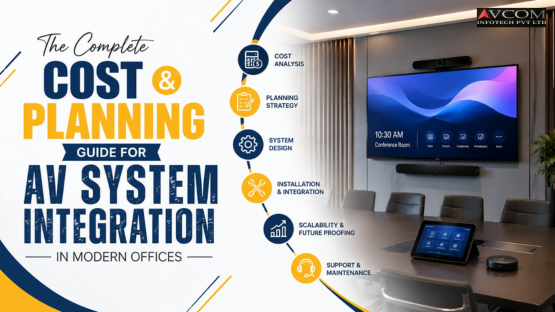
AVCOM infotech helps you plan your AV IT integration by assessing your current network infrastructure, designing a standardized hardware rollout, and deploying centralized management tools. We bridge the gap between AV installers and IT administrators to ensure your meeting rooms are secure, scalable, and easy to use.
Designing a converged AV IT infrastructure requires a partner who understands both sides of the equation. You need a team that knows how to configure enterprise network switches and how to calibrate a 4K display. As a Top Audio Visual System Integration Company in India, we build systems that fit your specific operational requirements.
Our approach focuses on standardizing hardware rollouts for consistency across all your locations. We implement IT service management frameworks so your AV assets are monitored and supported just like your standard IT hardware. From Top AV Solutions | AV Collaboration Company in india to full network integration, we handle the entire deployment lifecycle.
Ready to upgrade your meeting spaces? Contact AVCOM: Expert AV & IT Solutions for Your Business today to start planning your integration. You can also connect with us on Facebook, Instagram, or LinkedIn to see our latest AV deployments.
| Aspect | Traditional Standalone AV | Converged AV IT Infrastructure |
|---|---|---|
| Signal Transport | Baseband video (HDMI, SDI, VGA) via matrix switches | AV over IP (NDI, Dante) via standard network switches |
| Management | On-site troubleshooting and isolated control processors | Centralized dashboards with remote monitoring and updates |
| Security | Minimal security policies on isolated hardware | Enterprise authentication (802.1X), VLANs, and regular patching |
| Support Model | Unpredictable break-fix model requiring site visits | IT service management frameworks with proactive ticketing |
| Scalability | Difficult to scale across distributed locations | Standardized hardware rollouts ensuring global consistency |
1. What does AV IT convergence mean?
AV IT convergence is the process of moving audiovisual hardware onto standard IT network infrastructure. It replaces isolated AV islands with networked solutions, allowing IT and AV teams to operate from the same playbook. This enables remote management, automated updates, and consistent security policies across all corporate communication devices.
2. Why do modern meeting rooms need integrated AV and IT solutions?
Modern meeting rooms need integrated AV and IT solutions to improve collaboration by moving video conferencing, digital signage, and access control onto a single unified management layer. This eliminates hardware troubleshooting that derails meetings, allowing employees to focus entirely on their discussions rather than the technology enabling them.
3. What is AV over IP and how does it relate to IT convergence?
AV over IP compresses and packetizes audiovisual content to stream over standard Ethernet using protocols like Dante and NDI. It replaces traditional hardwired matrix switches with standard network switches. This allows video, audio, and control signals to travel over the same physical cables as standard office data, driving IT convergence.
4. What are the main challenges of AV IT integration for meeting rooms?
The main challenges of AV IT integration are bridging the skills gap between AV installers and IT administrators, and ensuring network security. AV teams must learn networking principles while IT teams must understand real-time video bandwidth requirements. Additionally, every connected device introduces new attack surfaces that require strict security policies.
5. How does converged AV IT infrastructure improve enterprise security?
A converged AV IT infrastructure improves enterprise security by allowing IT teams to apply consistent policies across all devices and streams. Security teams can implement 802.1X network authentication for AV hardware, isolate AV traffic on strict VLANs, and ensure that all endpoints receive regular automated security patches from a centralized dashboard.