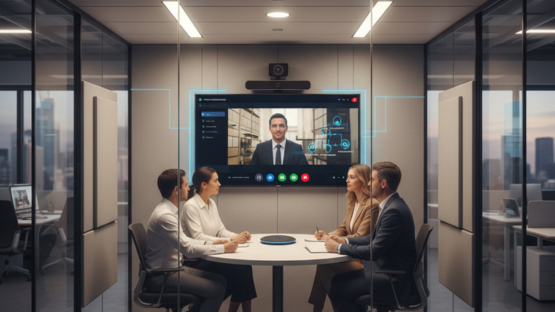
"Remote participants cannot hear what the in-room people are saying, and we are having to repeat a question or answer." A recent Spiceworks community thread highlighted this exact frustration from an IT admin managing a 35 x 35 foot space. When you host forty people in a room with a single basic microphone, the audio fails. You need a specialized meeting room microphone to bridge the gap between local speech and remote listeners.
Selecting the right meeting room microphone requires understanding your room's acoustics, choosing the correct pickup pattern, and integrating the hardware with your unified communications platforms. This guide breaks down exactly how to choose a meeting room microphone for Indian corporate spaces, drawing on real-world deployment analysis from AVCOM infotech.
The best microphone for conference rooms in India is a 360-degree array microphone or a ceiling array solution that offers active noise cancellation and integrates natively with your existing UC platforms. You must evaluate your specific room size and acoustic properties before buying, as a device that works in a huddle room will fail in a boardroom.
According to a VOIP Supply guide on large conference phones, a high-quality microphone array offering 360-degree coverage and noise cancellation features is ideal for larger groups. Devices like the Yealink CP965 use a 13-microphone array to capture voices clearly from all directions. For Indian buyers, finding the best microphone for conference rooms in India means looking at both these dedicated conference phones and dedicated ceiling-mounted hardware.
A 10x10 foot huddle space needs completely different hardware than a 35x35 foot boardroom. In small rooms, a simple tabletop meeting room microphone picks up everything. In large rooms, distance kills audio quality. Hard surfaces like glass windows and marble tables reflect sound, creating echoes that confuse remote listeners. You must map your room dimensions and note the reverberation before you buy a meeting room microphone.
Your hardware must talk to your software. A professional meeting room microphone should connect directly to Microsoft Teams Rooms (MTR) or Zoom Rooms without requiring complex workarounds. USB plug-and-play setups work well for small deployments. For larger professional conference audio systems, Dante audio networking routes multiple audio channels over a standard IP network, giving you clean integration with your AV infrastructure.
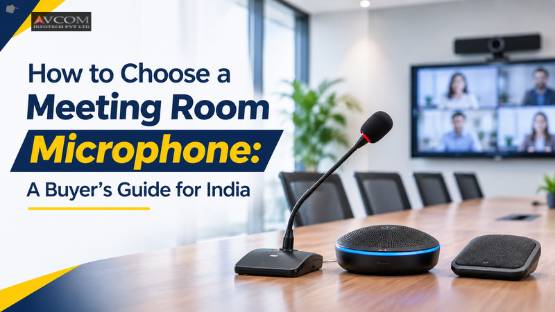
Omnidirectional microphones capture sound equally from all directions, making them perfect for round-table discussions where participants sit around the device. Directional microphones focus on a specific area, rejecting noise from the sides and rear, which makes them better for podiums or long boardroom tables. The omnidirectional vs directional microphones debate comes down to how your room dictates sound capture.
An omnidirectional meeting room microphone pulls audio from a 360-degree radius. If your executives sit around a circular table, this pattern ensures everyone is heard without needing to lean into a specific mic. The VOIP Supply guide notes that variations of these arrays range from built-in models to expandable systems with external mics. This flexibility makes them a standard choice for general conference spaces.
Directional microphones reject background noise by focusing on a narrow pickup area. Use a directional meeting room microphone when you have a presenter addressing a room from a fixed position, or when you need to ignore the noise coming from an open hallway. Cardioid and supercardioid patterns isolate the speaker's voice, preventing the HVAC system or side conversations from bleeding into the call.
Boundary microphones for conference rooms are an excellent choice when you want to capture clear audio from a flat surface without picking up the reverberations of the room. They sit flush on a table, using the surface itself to amplify the sound waves. This design minimizes phase cancellation, giving you a clean, natural sound.
Place a boundary meeting room microphone on a hard, flat surface like a boardroom table. Position it centrally to capture the most voices. Because the microphone element sits at the boundary of the surface, it captures direct sound and reflected sound simultaneously. This prevents the hollow, echoing sound that happens when a tabletop mic sits too high.
Boundary mics reduce table noise because they sit flat against the surface. They do not pick up the low-frequency rumble of people tapping pens or typing on laptops. If your table experiences heavy vibrations, look for a boundary meeting room microphone with built-in shock mounting to further isolate the capsule from physical impacts.
Professional conference audio systems handle large spaces by scaling ceiling array microphones and using AI to actively track human voices while suppressing environmental noise. A single table microphone simply cannot cover a 40-person room. You need a distributed system that moves the audio pickup away from the table and closer to the speakers.
Ceiling array microphones solve the distance problem. By mounting the meeting room microphone in the ceiling, you place the pickup element directly above the speaking zone. According to the Spiceworks community discussion, IT admins dealing with large rooms specifically look into beamforming mic arrays because they focus directly on the speaker's voice. You can chain multiple ceiling arrays together using Dante audio networking to cover massive boardrooms without signal degradation.
Modern professional conference audio systems use artificial intelligence to isolate human speech. The AI Speech Ceiling Microphone solution provided by AVCOM infotech, in collaboration with the Cavitak Team, uses AI to track voices dynamically. The system actively suppresses paper rustling, keyboard typing, and air conditioning hum. It zeroes in on the person speaking, adjusting the pickup beam in real-time. This is the core advantage of an AI-driven meeting room microphone.
You should choose AVCOM infotech because the team pairs technical excellence with hands-on deployment experience, specifically addressing the acoustic challenges found in Indian corporate environments. They do not just sell hardware. They analyze your space, recommend the right meeting room microphone, and integrate it with your broader IT and network security solutions.
AVCOM infotech delivers smarter, more effective solutions through continuous learning and technical excellence. Their collaboration with the Cavitak Team brings the AI Speech Ceiling Microphone to Indian boardrooms. This partnership ensures your meeting room microphone setup uses advanced voice tracking and noise suppression algorithms tested in real corporate deployments.
Hardware alone does not guarantee clear audio. The physical deployment matters. AVCOM specialists Mr. Faiz and Mr. Janesh Patel provide expert review contributions and practical recommendations based on real-world acoustic challenges. Their first-hand deployment analysis ensures your meeting room microphone captures every voice in the room without introducing echo or distortion. You can connect with their team on LinkedIn to review their AV integration expertise.
You maintain your meeting room microphone setup by scheduling routine firmware updates, checking hardware connections, and recalibrating the system whenever you change the room configuration. A static system degrades over time as software environments shift and furniture moves.
Manufacturers release firmware updates to improve noise cancellation algorithms and fix UC platform compatibility issues. Check your devices quarterly. Inspect the physical cables connecting your meeting room microphone to the DSP or MTR. A loose USB or Dante cable causes intermittent audio drops that users mistake for acoustic failures.
When you reconfigure a boardroom for a new layout, your audio setup must follow. If you move tables, reposition your boundary microphones to match the new seating arrangement. If you add new hard surfaces, your AI ceiling microphone may need a recalibration to account for the new reflection paths. Stay proactive to keep your audio clear. For a wider look at room-level tuning, read how to optimize your meeting room AV system for virtual and in-person collaboration.
Choosing the right meeting room microphone means matching your hardware to your room size, selecting the correct pickup pattern, and leveraging AI to handle complex acoustics. For large Indian corporate spaces, a ceiling array microphone with active noise suppression delivers the best results. Stop repeating questions for remote participants. Upgrade your audio, secure your network, and let the technology do the heavy lifting.
Ready to optimize your corporate AV setup? The AVCOM infotech team provides tailored integration services for your space. Contact the AVCOM infotech team today to schedule a consultation.
To see their latest deployments, follow AVCOM infotech on Facebook and Instagram.
| Microphone Type | Best Use Case | Key Advantage |
|---|---|---|
| Omnidirectional | Round-table discussions | 360-degree voice pickup |
| Directional | Podiums and fixed presentations | Rejects background and side noise |
| Boundary | Flat boardroom tables | Reduces phase cancellation and table vibrations |
| AI Ceiling Array | Large corporate boardrooms | Dynamic voice tracking and active noise suppression |
1. What is the best microphone for conference rooms in India?
The best microphone for conference rooms in India is a 360-degree array microphone or a ceiling array solution. It should offer active noise cancellation and integrate natively with your existing unified communications platforms to handle local acoustic challenges effectively.
2. What is the difference between omnidirectional and directional microphones?
Omnidirectional microphones capture sound equally from all directions, making them perfect for round-table discussions. Directional microphones focus on a specific area while rejecting side and rear noise, making them ideal for podiums or fixed presentations in noisy environments.
3. Are boundary microphones good for conference rooms?
Yes, boundary microphones are excellent for conference rooms. They sit flush on flat surfaces, using the table to amplify sound while minimizing phase cancellation. This design reduces low-frequency vibrations and prevents echoing, providing clean audio for meetings.
4. How does an AI Speech Ceiling Microphone improve meeting audio?
An AI Speech Ceiling Microphone improves audio by using artificial intelligence to dynamically track human voices and suppress environmental noise. It isolates the speaker, actively filtering out paper rustling and HVAC hum, which delivers clear sound without picking up table vibrations.
5. How do I choose a professional conference audio system?
To choose a professional conference audio system, evaluate your room size and acoustics first. Opt for scalable ceiling array microphones with Dante audio networking for large spaces, ensuring the hardware integrates directly with your video conferencing software.