A meeting starts five minutes late because someone cannot find the right adapter. Another ends with remote workers complaining they could not hear the presenter over the air conditioner. These daily friction points cost businesses thousands of hours in lost productivity every year. Artificial intelligence fixes this by embedding decision-making directly into the hardware.
AI in AV solutions integrates machine learning with audio-visual technology to automate meeting room controls, enhance audio clarity, and optimize video feeds. By utilizing smart features like voice recognition and predictive maintenance, businesses can streamline presentations, reduce technical friction, and create reliable hybrid collaboration environments.
AI-powered AV solutions for businesses are audio-visual systems that use machine learning algorithms to automatically manage, adjust, and optimize hardware functions without requiring manual user input. Instead of relying on a person to dim the lights, aim the camera, or tweak the microphone volume, the system senses the room environment and makes those adjustments on its own.
The intersection of these two fields comes down to sensory input and automated response. Standard AV equipment captures sound and video. When you add artificial intelligence, that captured data is analyzed in real time. A digital signal processor from a manufacturer like Shure does not just record audio; it distinguishes a human voice from ambient HVAC noise and suppresses the background interference. The equipment acts on the data it gathers.
Old conference rooms required a physical control panel for every action. You had to press a button to lower a projector screen, select an input source, and dial into a video bridge. Modern setups remove those steps. Crestron hardware, for example, uses presence detection to wake the room when someone walks in. It reads the calendar, connects the call, and configures the display before the user even sits down. The room runs itself.
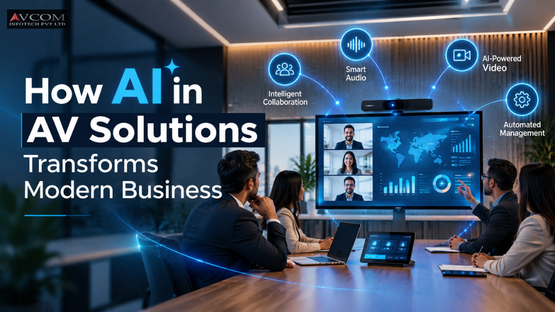
AI is transforming AV systems for daily operations by embedding computer vision and advanced audio processing into standard hardware, allowing cameras to track active speakers automatically and microphones to isolate human voices from ambient room noise. This removes the need for manual camera operators and constant audio adjustments during live calls.
Computer vision technology drives modern conference cameras. The software analyzes the video feed pixel by pixel to identify human faces and postures. When a presenter stands up and moves to the front of the room, the camera pans, tilts, and zooms to keep them centered in the frame. If someone in the back row asks a question, the camera cuts to that speaker. This mimics a live television production crew. It keeps remote participants engaged because they can actually see who is talking.
Audio problems derail more meetings than video issues. According to Poly, their NoiseBlock technology uses AI to differentiate between human speech and stationary background noise like typing or paper rustling. The algorithm instantly mutes the noise while preserving the voice.
Acoustic echo cancellation works similarly. When a remote participant speaks through the room's loudspeakers, the local microphone picks up that sound. AI algorithms identify that acoustic signature and strip it out of the outgoing audio stream. This prevents the echoing effect that makes hybrid meetings so frustrating.
AI-powered meeting room solutions are essential for hybrid work because they create audio and visual equity between remote and in-office participants. The technology ensures that distributed workers experience the same audio clarity and visual context as the people sitting in the physical room, preventing the communication breakdowns that plague standard conference setups.
In a traditional room, the remote workers are a small face on a laptop perched at the end of a conference table. They cannot see the whiteboard, and they cannot hear the person whispering two seats away. AI fixes this imbalance. Smart microphones mounted in the ceiling use beamforming to isolate and amplify whoever is speaking, regardless of where they sit. Simultaneously, the camera's auto-framing provides remote workers with a clear view of the speaker. The remote worker gets a front-row seat.
Booking a room should not require an email chain. AI-powered meeting room solutions integrate directly with platforms like Microsoft Teams. The system reads the corporate calendar and reserves the room automatically. If nobody shows up within ten minutes of the start time, sensors detect the empty room, cancel the reservation, and free the space for someone else. This maximizes real estate usage. Facility managers get hard data on which rooms are actually used and which ones sit empty, allowing them to reclaim or reconfigure wasted space.
AI improves AV system reliability by constantly monitoring hardware performance data to predict component failures before they happen and by enabling remote technicians to diagnose and resolve software issues without dispatching a technician to the physical room. This shifts maintenance from a reactive break-fix model to a proactive service.
A projector lamp does not burn out instantly. It dims over hundreds of hours. A capacitor in a display panel degrades slowly. AI systems track the operational telemetry of these components. When a microphone's signal-to-noise ratio drops below an acceptable baseline, the AI flags the device for replacement. It catches the degradation weeks before the hardware actually dies. IT replaces the failing part on a Tuesday afternoon instead of scrambling to fix it during a Monday morning board presentation.
When a meeting room system crashes, the IT department usually gets a vague help desk ticket. AI changes this workflow. The system generates a specific error code and sends it to the network operations center. A technician can log in remotely, see that a specific HDMI matrix switch failed to handshake, and push a firmware reboot to that specific node. The room is back online in two minutes.
AI in AV introduces security and privacy considerations primarily through the constant presence of networked microphones and cameras in corporate spaces. Businesses must protect sensitive meeting data by enforcing strict network encryption protocols and establishing clear corporate policies regarding when and how the AI hardware is allowed to listen and record.
AV hardware is now an endpoint on the corporate IT network. It must be treated like a server or a workstation. Reputable AV manufacturers build their systems to comply with enterprise security standards. Video and audio streams are encrypted in transit using protocols like TLS. Device management ports are locked down. Integrating these tools requires the same network security rigor applied to the rest of the corporate infrastructure. You can review enterprise security standards through AVCOM infotech network security solutions to ensure your AV deployment does not create a backdoor into your corporate data.
A camera that auto-tracks your every move can feel invasive. Companies must establish clear boundaries. Many modern systems include physical hardware switches that physically disconnect the microphone and camera when not in use. IT administrators must also configure the AI to process speech and video locally on the room device rather than uploading raw audio streams to a cloud server for analysis. Privacy policies need to explicitly state what the room records, how long the data is stored, and who has access to it.
A business successfully transitions to AI-powered AV by conducting a thorough infrastructure audit to identify network bandwidth limitations, evaluating the compatibility of existing legacy hardware, and partnering with certified integration specialists who can map the deployment to specific operational goals rather than buying generic off-the-shelf hardware.
You cannot plug an AI-powered 4K camera into a ten-year-old network switch and expect it to work. The first step is a hard look at the physical infrastructure. Does the room have sufficient Category 6a cabling to handle the bandwidth? Is the PoE switch capable of delivering enough power to the new endpoints? Will the existing video conferencing software support the new API calls? An audit answers these questions. It prevents expensive hardware from sitting in boxes because the building cannot support it.
Buying the hardware is the easy part. Making it work together is difficult.
"Transitioning a legacy conference room to an AI-driven environment is rarely a plug-and-play operation. We see companies fail when they try to piece together hardware from five different manufacturers without a unified control plan. You need a systems integrator to write the code that makes the camera, the microphone, and the control panel talk to each other seamlessly," says a senior integration specialist at AVCOM infotech.
A certified integrator programs the room logic. They ensure the system works on day one.
The future of AI in the audio visual industry points toward deeply immersive, adaptive workspaces that combine spatial audio, augmented reality, and machine learning to anticipate user needs before the meeting begins. The room will adapt to the people, rather than the people adapting to the room.
Stereo audio places sound on the left or right. Spatial audio places sound in a three-dimensional environment. When combined with AI, a remote worker's voice can be mapped to their position on the video display. If a person on the left side of the screen speaks, you hear their voice from the left speaker. This spatial awareness reduces cognitive load. You do not have to work as hard to figure out who is talking. Augmented reality will take this further by overlaying 3D digital models onto the physical conference table, allowing hybrid teams to manipulate the same object simultaneously.
Machine learning will make the room predictive. The system will learn that the marketing team always dims the lights and lowers the shades for their Tuesday presentations. The AI will begin to prepare the room automatically before the meeting invite even populates on the calendar. The hardware will learn the acoustics of the room and adjust microphone sensitivity based on how many people are present. The room becomes a living, responsive environment.
AI is fundamentally changing how we collaborate. The technology removes the friction that makes hybrid work difficult. If you are ready to upgrade your conference rooms, contact the integration team at AVCOM infotech to schedule an infrastructure assessment. You can also connect with AVCOM infotech on LinkedIn or visit AVCOM infotech to learn more about our deployment strategies.
| Feature | Traditional AV Systems | AI-Powered AV Solutions |
|---|---|---|
| Meeting Start | Manual input selection and dial-in | Presence detection and auto-connect |
| Camera Control | Static angle or manual operation | Auto-framing and speaker tracking |
| Audio Processing | Basic noise gating | AI noise cancellation and echo reduction |
| Maintenance | Reactive break-fix model | Predictive analytics and remote monitoring |
| Room Booking | Manual scheduler and email chains | Automated scheduling with empty room release |
What exactly are AI-powered AV solutions?
AI-powered AV solutions are audio-visual systems that use machine learning to automatically manage hardware functions without manual input. They analyze sensory data to adjust cameras, tweak microphones, and configure displays. This creates a seamless environment where the technology adapts to the users, eliminating the need for manual adjustments.
How does AI improve audio quality in meeting rooms?
AI improves audio quality by using advanced algorithms to differentiate human speech from background noise. It instantly suppresses stationary sounds like typing or air conditioners while preserving voices. Additionally, acoustic echo cancellation prevents feedback loops, ensuring remote participants hear clear audio without distracting echoes.
Can AI AV systems integrate with existing legacy hardware?
Integrating AI AV systems with legacy hardware requires a thorough infrastructure audit. Older network switches often lack the bandwidth to support 4K cameras. Businesses must evaluate cabling and power requirements before deployment. Partnering with integration specialists ensures new and legacy components communicate seamlessly through custom programmed control logic.
How does AI predictive maintenance work for AV equipment?
AI predictive maintenance monitors hardware performance data to prevent failures. The system tracks operational telemetry like signal-to-noise ratios and component degradation. By catching these drops early, IT can replace failing parts before they break. This proactive approach prevents costly downtime during critical meetings.
Are AI-powered meeting room solutions secure for confidential corporate data?
AI-powered meeting room solutions are secure when properly configured. Reputable manufacturers encrypt audio and video streams using secure protocols. IT administrators can process data locally to avoid cloud uploads. Physical hardware switches also disconnect microphones and cameras, ensuring privacy when rooms are not in use.